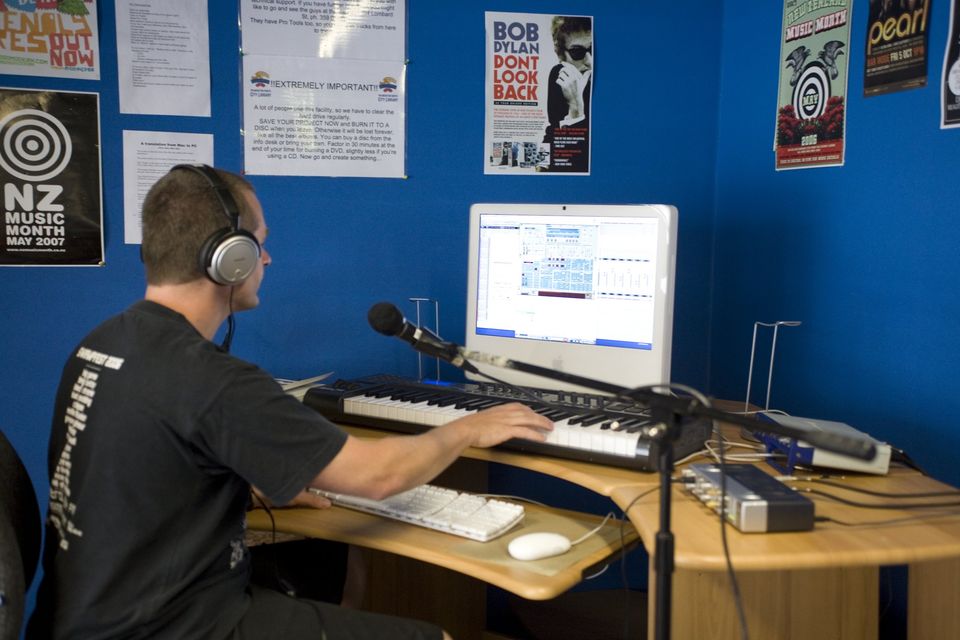
Image credit: Beat Booth by Living Room of the City, 2009, Flickr. (https://flic.kr/p/68w8sW) CC BY-NC 2.0 Selecting and preparing your recording space has a significant impact on the quality of your presentational audio.
Background Noise
This is any unwanted sound present in your recording space. It could be people nearby, pets, weather like wind or rain, traffic, fans, heating, or air conditioning. These can all reduce the clarity of your audio content.
Measurement
You can measure the amount of background—or any other—noise in your environment using a sound level meter app (iOS-only) from the US National Institute for Occupational Safety and Health (NIOSH). It was designed to help protect workers from hearing loss while on the job, but you can also use it to generate an objective, real-time measurement of the current background noise.
Activity
Take a moment now to close your eyes and listen for as many background sounds as you can. Perhaps you can hear appliances whirring in the next room, neighbors mowing their lawns, or emergency vehicles on a nearby road. Any of these could potentially show up in your recording. Write down as many ambient noises as you hear. Try repeating this exercise in each of your possible recording spaces or with doors and windows closed.
Room Acoustics
Acoustics are a product of the physical characteristics which affect sound waves in your space. There are many nuances which can affect the quality of your audio, but an important one is reverberation. If your space is large with many hard, symmetrical surfaces, this can lead to reflected echoes, making your words less intelligible. However, the opposite can also be troublesome:
Recording studios usually contain a mixture of hard surfaces such as wood and soft surfaces such as carpet. The mix of hard and soft surfaces will create a balance between the room sounding too live and too dead…. Another popular piece of advice for podcasters is that they should record in their closet… [but] the closet has too many soft surfaces in the form of your clothes. These soft surfaces absorb too much of the high-frequency sounds, making speech sound muffled or dead (Green, 2021, p. 122)
The ideal space is one which is not too big or small with a variety of hard and soft materials (p. 125).
Preparing the Recording Space
If your space is overly reverberant, use soft materials such as area rugs, blankets, pillows, and drapes to help prevent bouncing sound waves. This also helps soundproof the room from unwanted background noise.
In addition, close any doors and windows which allow in any unwanted sound. Roll up a towel and place it in the gap under the door. Turn off any fans, air conditioners, or unneeded appliances. You can also record at times when your environment is quieter, such as at night.
Selecting a Space
The best space in which to record may be your local library. Many libraries now offer dedicated recording spaces for musicians and podcasters. This also saves you the trouble and cost of purchasing dedicated audio equipment.
If you can find such a facility, I would highly recommend using it, because this will give you the best value for money. The council or library generally provides training for the use of their equipment (Green, 2021, p. 115).
Some even allow you to book time with an audio engineer, such as at the Spokane Public Library.
Using the measurement app above and trial recordings, try comparing the qualities of each of the candidate recording spaces in your home, office, or local library.
Library Recording Studios
Here are some examples of libraries which provide recording spaces:
- Allen County Public Library Maker Lab
- Brooklyn Public Library Information Commons
- Chattanooga Public Library Studio
- Gwinnett County Public Library Lilburn Learning Lab
- Joliet Public Library Digital Media Studio
- Lawrence Public Library SOUND+VISION Studio
- Palmerston North City Library Sound and Vision Zone
- Peoria Library Podcast Studio
References
Green, C. M. (2021). Recording Inside. In The Podcaster’s Audio Handbook (pp. 113–128). Apress. https://doi.org/10.1007/978-1-4842-7361-6_5