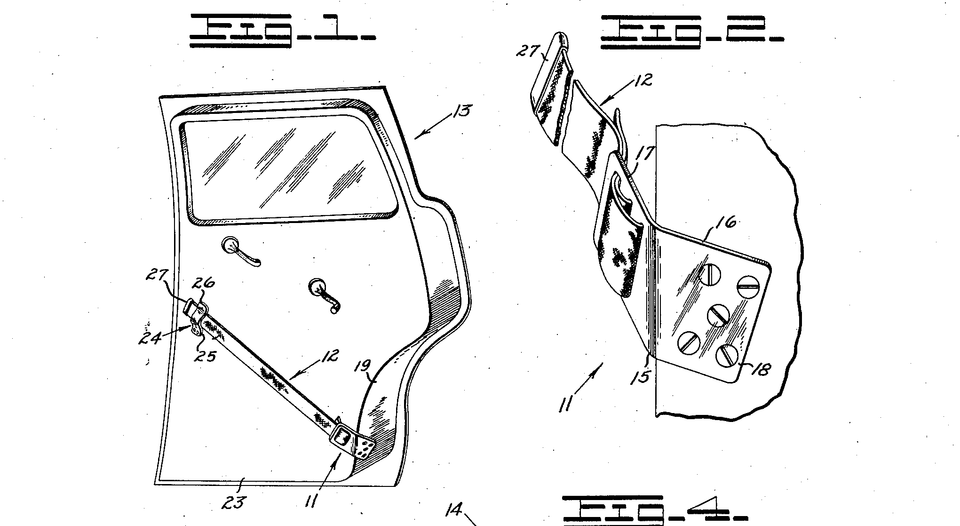
I wanted to know how long it took humans to invent the modern automobile seat belt. We take them for granted now as they are ubiquitous. But they weren't for a long time and I wanted to know for how long.
The answer, as always, depends on how you count. The first fatality in a steam carriage was in 1834, possibly due to an intentionally placed obstruction [1]. The first fatality in a motor car was scientist Mary Ward riding aboard a steam car in 1869. The modern consumer automobile was developed in 1886 (Benz), but lap belts were not available as a factory option until 1949 (Nash). Even then, nobody wanted them (the seat belts, that is, but Nash too.) The three point harness in cars was not patented in the US until 1955 and only started to be sold by Saab in 1958.
So for something like 72 years depending on how you count (from Benz to Saab, roughly), we as a species sold consumer cars without what we now consider to be basic safety equipment. And when we did, at least in the US, consumers shunned them. That's almost three generations! Benz made cars that would kill at a minimum his generation's children and grandchildren but for lack of a single essential design element.
Humans had already invented the seat belt by the turn of the century. The first modern seat belts were not in cars; they were designed for airplanes. This makes sense, as planes can yaw, pitch, and roll in the course of flight. WWI pilots had safety harnesses including seat belts, but these were designed for part of normal operation, not crashes [2].
Cars, on the other hand, are typically yaw only, what we call steering or turning. When cars pitch, this is usually due to a change in the grade of the road and not the driver unless Bullitt is on a high speed chase through San Francisco or Thelma and Louise are driving off a cliff. (Though note the ending freeze frames before the pitch changes to down which is a visually disconcerting angle for a car, as Ridley Scott knew.) Similarly when cars start to roll, the chase is probably over. Cars did not have safety harnesses because they were not required for regular operation, but at the slower speeds compared to flight they could save the driver in a crash.
The first consumer cars were somehow both an incredible design success and a colossal failure, and it took our children's children to work it out. We invented something both economically useful and absurdly dangerous. The same can of course be said about a great number of human technologies, from lead drinking vessels to asbestos, but I keep thinking about that 72 year lag between the invention of the automobile and the modern safety belt.
To state the obvious, humans are maybe not so great at anticipating failure conditions. It is up to designers and engineers to expect these failure states as possible outcomes. But for more systemic analysis in all its complexity, we might be less likely to turn out engines which explode, whether powered by steam or lithium-ion. We eventually thought about cars as if they were not independent of the other drivers, passengers, pedestrians, animals, trees, my mailbox, and parts of my front porch thanks to this guy Dennis. Like the backup driver falling asleep at the wheel of a self-driving taxi, we didn't know the danger we were in.
I wonder sometimes whether we are at a similar place in time as during those 72 years. Even today, cars have been produced for longer without than with modern seat belts and will until 2030, by this measure. And yet, I have a feeling the basic safety apparatus around AI is not yet in place. What are the unanticipated failure modes? What is the seat belt or the antilock brakes we're currently missing for LLMs and other generative AI? For agentic AI on the Internet (or AAII for short, also the sound I make) the current casualities may be executive emails and the reputation of open source developers, but it is only a matter of time before we experience AAII across the whole of the network. I don't think the world is yet prepared for what this means.